


Development And Employment Of Fixed-Wing Gunships 1962-1972
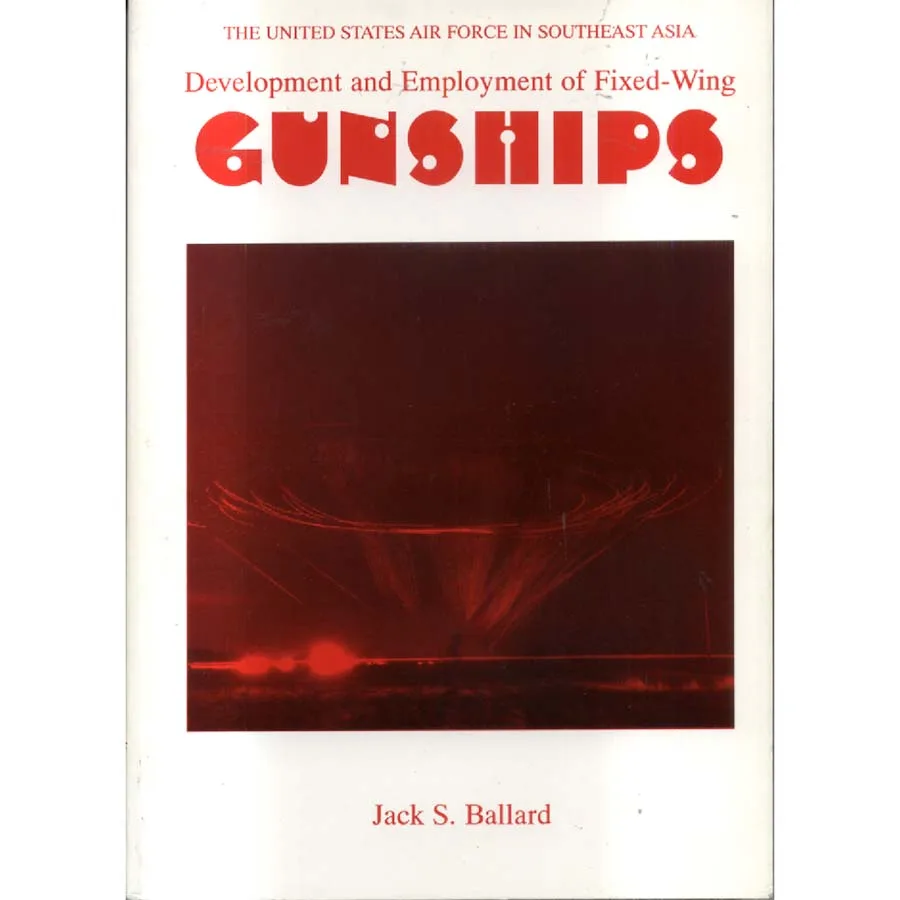
Publisher: Office of Air Force History
Format: Paperback
ISBN: none
The fixed-wing gunship began with an apparently unreasonable proposition: take an elderly transport aircraft, install machine guns pointing sideways and fly in circles above the target. Conventional wisdom suggested that an aeroplane should point its weapons towards whatever it intended to shoot. Experience in Vietnam suggested that conventional wisdom had overlooked the usefulness of geometry.
In Development and Employment of Fixed-Wing Gunships, 1962–1972, Jack S. Ballard traces the creation and combat history of one of the United States Air Force’s most distinctive weapon systems. Published by the Office of Air Force History, this is a detailed official study of the experiments, improvisations and operational demands that produced the AC-47, AC-119 and AC-130 gunships.
The central concept was deceptively simple. A pilot would place the aircraft into a banked orbit around a point on the ground while guns mounted along the side fired inward. By maintaining a pylon turn, the aircraft could keep a continuous stream of fire concentrated within a relatively small area. The gunship therefore flew around its target rather than over it, converting an old transport into something resembling an airborne revolving door fitted with miniguns.
The idea had roots in earlier experiments, but the particular demands of the war in Southeast Asia gave it urgency. Isolated forts, villages and outposts frequently came under attack at night. Fast jets could deliver enormous firepower but had limited time over the battlefield and could struggle to identify friendly positions in darkness. What defenders needed was an aircraft able to remain overhead, illuminate the area and apply accurate fire for an extended period.
Early trials under Project Tailchaser used a Convair C-131 to prove that side-firing weapons could be aimed effectively during an orbit. The experiments were improvised, inexpensive and sufficiently successful to create institutional concern. Military organisations are accustomed to costly development programmes; a useful idea assembled quickly from existing equipment can be more disruptive.
The first operational gunship was the AC-47, developed from the Douglas C-47 Skytrain—the military descendant of an airliner already old enough to possess wartime memories. Armed with rapid-firing miniguns and equipped to drop flares, it became known officially as Spooky and unofficially as Puff the Magic Dragon. The cheerful nickname described an aircraft capable of placing a dense stream of tracer fire around a besieged position, proving that military humour enjoys contrast.
AC-47s defended hamlets and bases, supported troops in contact and provided night fire over areas where enemy forces expected darkness to offer protection. Their long endurance allowed crews to remain with ground units during prolonged attacks. To friendly soldiers, the circling aircraft could be a profoundly reassuring presence; to anyone approaching the perimeter with hostile intentions, the reassurance was distributed unevenly.
Ballard examines how combat experience drove continuous modification. Crews, engineers and development teams exchanged information between Southeast Asia and the United States, identifying problems and producing rapid solutions. Weapons, sights, sensors and operating procedures evolved through the useful but hazardous process of testing equipment while the opposition was actively testing it in return.
Demand soon exceeded the available AC-47 force, leading to the conversion of Fairchild C-119 Flying Boxcars. The AC-119G Shadow was designed principally for close support and base defence, while the more heavily equipped AC-119K Stinger added jet engines, improved sensors and heavier armament for truck hunting and interdiction. The old cargo aircraft had acquired a new career because retirement planning is unreliable during a war.
The Lockheed AC-130 Spectre represented a much more sophisticated development. Based on the C-130 Hercules, it combined greater payload and endurance with advanced night-observation equipment, fire-control systems and increasingly powerful weapons. Miniguns and cannon turned the aircraft into a stable firing platform capable of locating and attacking vehicles along the Ho Chi Minh Trail.
Interdiction in Laos became one of the gunship’s major missions. North Vietnamese trucks moved supplies south through a concealed network of roads, tracks and storage areas, often operating at night. AC-130 crews used sensors to find traffic beneath darkness and vegetation, then orbited while engaging it. The resulting contest involved machines designed to hide on the ground and a machine designed to remain overhead until hiding ceased to be persuasive.
The book follows the expansion of armament from rifle-calibre miniguns to 20mm and 40mm cannon, giving later gunships a level of firepower unimaginable aboard the original C-47 experiments. Every increase promised better results and encouraged the enemy to provide heavier anti-aircraft weapons. Technological advantage remains an invitation for the other side to become inventive.
Gunships were highly effective but also vulnerable. Their missions required predictable orbits, relatively low speeds and prolonged exposure to ground fire. As North Vietnamese defences gained radar-directed guns, surface-to-air missiles and better coordination, operating over heavily defended routes became increasingly dangerous. The aircraft could deliver astonishing firepower, but size and endurance did not make them invulnerable.
Ballard also examines the bureaucratic struggle behind development. Advocates had to prove the concept, obtain aircraft, integrate weapons and persuade established commands that an unconventional system deserved resources. Fighter pilots, procurement officials, engineers and operational commanders approached the proposal from different institutional directions. The gunship therefore had to survive both enemy fire and the acquisition process.
Because this is an official Air Force history, the book offers far more than a popular account of dramatic missions. It explores tests, programme decisions, combat evaluations, organisational arrangements and the relationship between battlefield requirements and technical development. The detail is supported by photographs, maps, tables and documentation, making it particularly useful to researchers and serious aviation enthusiasts.
The period ends in 1972, by which time the fixed-wing gunship had progressed from a provisional experiment to an established combat system. The later career of the AC-130 would extend across numerous conflicts, but the essential combination of side-firing weapons, sensors, endurance and precise orbiting attack had been formed in Southeast Asia.
This book will appeal to readers interested in the Vietnam air war, special operations, close air support, military technology and aircraft converted far beyond their manufacturer’s original intentions. It is also a fascinating study of innovation: an idea initially peculiar enough to require explanation became so effective that several generations of increasingly sophisticated aircraft followed it.
This copy is in Good condition, showing ordinary signs of age and previous ownership but remaining fully serviceable for historical operations. Offered by Crappy Old Books, it is a detailed account of Spooky, Shadow, Stinger and Spectre—the aircraft that proved a cargo hold could become a weapons bay and that sometimes the most effective way to attack a target was to fly around it repeatedly.
Keep browsing: See more War books Other books by Jack S Ballard
